Showing posts with label book reviews. Show all posts
Showing posts with label book reviews. Show all posts
Monday, February 4, 2008
Three Cups of Tea
I just finished a book review over at Reba Reads and (can you believe it?) -- I liked the book! Check it out, your husbands might like this one, too.

Monday, January 21, 2008
Book 1: The Higher Power of Lucky

The Higher Power of Lucky, written by Susan Patron, is a middle grade fiction book that won the Newbery in 2007. It's about a 10 year-old girl in a teeny tiny trailer park town who's living with a French woman who was married to her father before her father married her mother. Her mother died two years ago when she was electrocuted by a downed power line in after a desert rain, her father never wanted children, and her not quite related guardian always seems on the edge of returning to France--perhaps without Lucky. She's never sure about her parental situation, so she keeps a survival full of insect specimen jars and the 12 step book with her in case she gets stranded. The book's title comes from Lucky's habit of watching all the 12 step Anonymous meetings from a hole in the back of the meeting place. She's captivated by the recoveree's stories of hitting rock bottom and then finding a higher power and putting their lives back together; and she's also interested in finding some way to get her life back together as well.
Even with a I'm-running-away-so-everyone-will-know-how-much-they-miss-me storyline, there's a lot to like about this book: the desert setting, likeable adults, quirky main characters, and flowing descriptive writing. The story is narrated by 10 year old Lucky, which is at once the book's beauty and downfall. Because of Lucky's age, she doesn't understand much of her situation and so her reactions to it are at once endearing and confusing.
Ultimately it was the lack of connectable plot that ruined the book for me. The story's climax comes when Lucky releases her mother's ashes into the desert, which seemed more like the author's choice than anything rising organically from Lucky. And the ending just happens instead of being motivated by any part of the story, so as much as I liked seeing Lucky's happy ending, I felt disappointed by never seeing how she found a higher power.
Sunday, December 23, 2007
Among the Hidden (first book in The Shadow Children series)

Meg gave me Margaret Peterson Haddix's Among the Hidden for our Children's Literature Book Club book exchange and I can see why it's a favorite.
ATH is about Luke, a third child, in a futuristic America where people are only allowed to have 2 children and Thirds (also known as shadow children) are hidden by parents or killed by the population police because of a law that came into effect after widespread famines. Luke lives the first years of his life in relative safety on his parent's remote farm, but after he turns 12, the government buys land from Luke's father and uses it to build a neighborhood for upperclass citizens, so Luke becomes a prisoner in his own home, terrified that he will be found out. The story gest interesting when Luke discovers another third child hiding in one of the new houses. He sneaks over to meet her and his life is changed forever . . .
Although Luke is a rounded enough character to be interesting even though he spends the majority of the book hiding in his house, the real star of the show is the futuristic society. ATH is written for a younger audience, but it brings up interesting points in an age appropriate way. This book could spark some really interesting discussions in as young as 3rd or 4th grade about the role of government, internet safety, snack food nutrition, rhetoric, and even civil disobedience.
As for my adult self, I keep thinking about this quote about how they helped impose the child limit:
"The Government went on this big campaign to make women think it was something evil to get pregnant and have kids. They put posters up in all the cities with things like, 'Who's the worst criminal?' under a picture of a pregnant lady and, I don't know, some tough looking crooks. And then if you read the whole sign it'd tell you the woman was the worst of all. Another one [. . .] had a picture of a huge pregnant belly, with the label, 'Ladies, do you want to look like this?'"
I don't know about you, but I think there are already a lot of pressures on women not to have as many or any children. Victoria Secret ads, pressure to have a career, devaluation of stay at home moms, etc. all make me think that maybe the Government wouldn't have to break the bank if they were to start a Population Control today.
ATH is the first book in a series, and the ending, while it does bring a little closure, is definetely a segue into the next book.
Friday, December 14, 2007
The Bright Forever
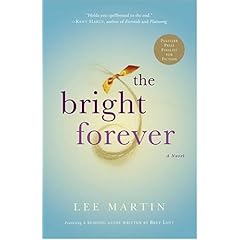
Lee Martin’s The Bright Forever was short listed for the Pulitzer Prize in 2005 and since he is a professor at The Ohio State University, I thought it appropriate to read as my last book in Ohio.
The book is set in 1970s Indiana and is told in multiple voices of people from the town. It centers around who is guilty for the disappearance of a 9 year old girl, Katie, on a summer evening. The book is labeled “literary suspense” and you really are kept in suspense about who did what to Katie until the last 5 pages of the book.
The book does have writing worthy of a Pulitzer short list, but the characters are all so unlikable that I couldn't really connect. The front jacket flap compares it to Alice Sebold’s The Lovely Bones, which, if you’re in the market for a book about what happens to a family after their daughter is murdered (and really, who ISN'T?), I would definitely recommend over The Bright Forever.
The book is set in 1970s Indiana and is told in multiple voices of people from the town. It centers around who is guilty for the disappearance of a 9 year old girl, Katie, on a summer evening. The book is labeled “literary suspense” and you really are kept in suspense about who did what to Katie until the last 5 pages of the book.
The book does have writing worthy of a Pulitzer short list, but the characters are all so unlikable that I couldn't really connect. The front jacket flap compares it to Alice Sebold’s The Lovely Bones, which, if you’re in the market for a book about what happens to a family after their daughter is murdered (and really, who ISN'T?), I would definitely recommend over The Bright Forever.
Saturday, December 8, 2007
Click
 When we were kids the six of us entertained ourselves playing a game called But Luckily. One of us started with a simple story and then we'd pass the story from one player to the next by saying "But luckily. . . " Stories got wild fast--running from Antarctica to the surface of the sun or the main character changing names, gender, or (this was always our favorite and I'm not sure why) hair color.
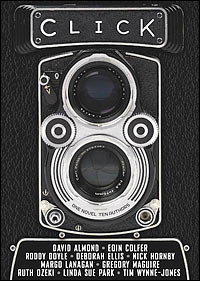
I picked up Click thinking that the But Luckily game combined with an impressive list of authors (Linda Sue Park--A Single Shard, Gregory MacGuire--Wicked, and Eoin Colfer-Artemesis Fowl series--to name a few) would be a perfect combination. It was not what I expected.
Basically this is a book of short stories where a handful of main characters may or not make an appearance in stories that are very loosely connected by a famous photographer who is now dead. The writing styles, while good, are so different from each other that it takes most of a chapter to get into it and then, well, it's on to another author. Maybe my mind is just frazzled right now, but I couldn't follow the snapshot stories and changing voices. I put the book down in the middle and don't plan on picking it back up.
That being said, the second chapter about a girl who is half mermaid was my favorite of what I read. And, the ISBN number is hidden in something that I think has something to do with a camera or taking pictures. We talked about hidden ISBN numbers at Children's Literature Book Club this week, so I felt very in the know:

Tuesday, December 4, 2007
The History of Love
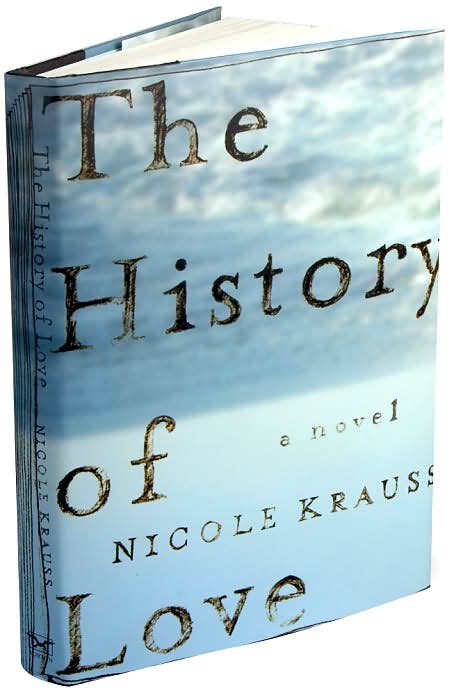
I finished The History of Love by Nicole Krauss this morning and wanted to make good on my promise to myself to remember the books I read. The book is written from the perspective of multiple narrators including a very old Jewish man (Leo), a 15 year old girl (Alma), Alma's 12 year old brother (Bird), and a traditional third person narrator. It is set in New York City.
The story centers on Leo who wrote a book called The History of Love fifty years earlier in Yiddish in Poland. He lost all most of his town during Hitler's occupation of Poland. The woman he loved, Alma, believed that Leo also died with the town and so married again and had a child with her new husband. In addition, Leo thinks the only copy of The History of Love was destroyed in a flood and lives alone, afraid of dying alone and leaving no legacy behind him. You'd think this would be terribly depressing, and although it is sad, Leo has such a great sense of humor and precise voice that his situation is at the same time tragic and endearing. For example:
"I try to make a point of being seen. Sometimes when I'm out, I'll buy a juice even though I'm not thirsty. If the store is crowded I'll even go so far as dropping my change all over the floor, the nickels and dimes skidding in every direction. I'll ge down on my knees. It's a big effort for me to get down on my knees, and an even bigger effort to get up. And yet."
Meanwhile, 15-year-old Alma was named after the main character in a book called The History of Love, and her mother, a translator, begins translating The History of Love from Spanish to English for a mysterious man with a lot of money. Because of this Alma becomes convinced that the Alma of the novel was a real person and begins a quest to find her.
The drama of the book comes from whether or not these two people will intersect, as well as how The History of Love went from being written in Yiddish in Poland to being published in Buenas Aires in Spanish.
The language of the book is arrestingly beautiful and the characters just original enough to be remembered while still being believable as "real" people. Despite both of them being lonely recluses, they are remarkably engaging.
I think this is a book that has a lot of layers to make for good discussion. And since there's no swearing or gratuitous sex, it would be great for an LDS reading group. I've included a link to reading group questions in case I ever want to suggest this book.
Subscribe to:
Posts (Atom)